


Every breath you take could be slowly harming you, and the science now backs this up more compellingly than ever. According to the World Health Organisation, almost all of the global population (99%) is exposed to air pollution levels that put them at increased risk for diseases including heart disease, stroke, chronic obstructive pulmonary disease, cancer and pneumonia. The situation is most acute in Africa, South and Central Asia, and parts of the Middle East, where pollution levels are over safe limits by staggering margins. Chad, for instance, recorded the highest annual PM2.5 concentration at 91.8 µg/m³ — nearly 18 times the WHO’s recommended safe level of 5 µg/m³.
Air pollution, as defined by the WHO, is the contamination of indoor or outdoor environments by any chemical, physical, or biological agent that alters the natural composition of the atmosphere. The sources are familiar to us, including household combustion devices, motor vehicles, industrial facilities and even forest fires. However, their collective toll is staggering. In 2021 alone, air pollution accounted for 8.1 million deaths globally, making it the second leading risk factor for death worldwide.
Critically, the threat is not confined to outdoor smog. Indoor air pollution from cooking stoves and solid fuels is equally dangerous, particularly in low- and middle-income countries where it disproportionately affects women and children. A UNICEF report states that around 500,000 child deaths below five years of age are linked to household air pollution due to cooking indoors with polluting fuels, mostly in Africa and Asia. Combined, ambient and household air pollution are responsible for worse health impacts and fatalities than those caused by tobacco and poor diet.
Tiny particles, known as PM2.5, sit at the heart of this crisis. They have a diameter of less than 2.5 micrometers and can penetrate deep into the lungs and cardiovascular system, increasing the risk of acute respiratory infections and non-communicable diseases, notably cardiovascular diseases, stroke, chronic lung disease and lung cancer. Globally, PM2.5 is linked to approximately 7 million deaths every year and causes the average person to lose around 2.3 years of life expectancy. WHO guidelines state annual average concentrations of PM2.5 should be below 10 micrograms per cubic meter, but the vast majority of the world’s population is living in areas exceeding this limit.
The best way to address this risk is to control or eliminate the sources of pollutants and to ventilate your home with clean outdoor air. The ventilation method may, however, be limited by weather conditions or undesirable levels of contaminants contained in outdoor air. When outdoor air quality is itself compromised, as it increasingly is across South Asia, ventilation alone is insufficient. This is where an air purifier for home becomes not a luxury, but a necessity.
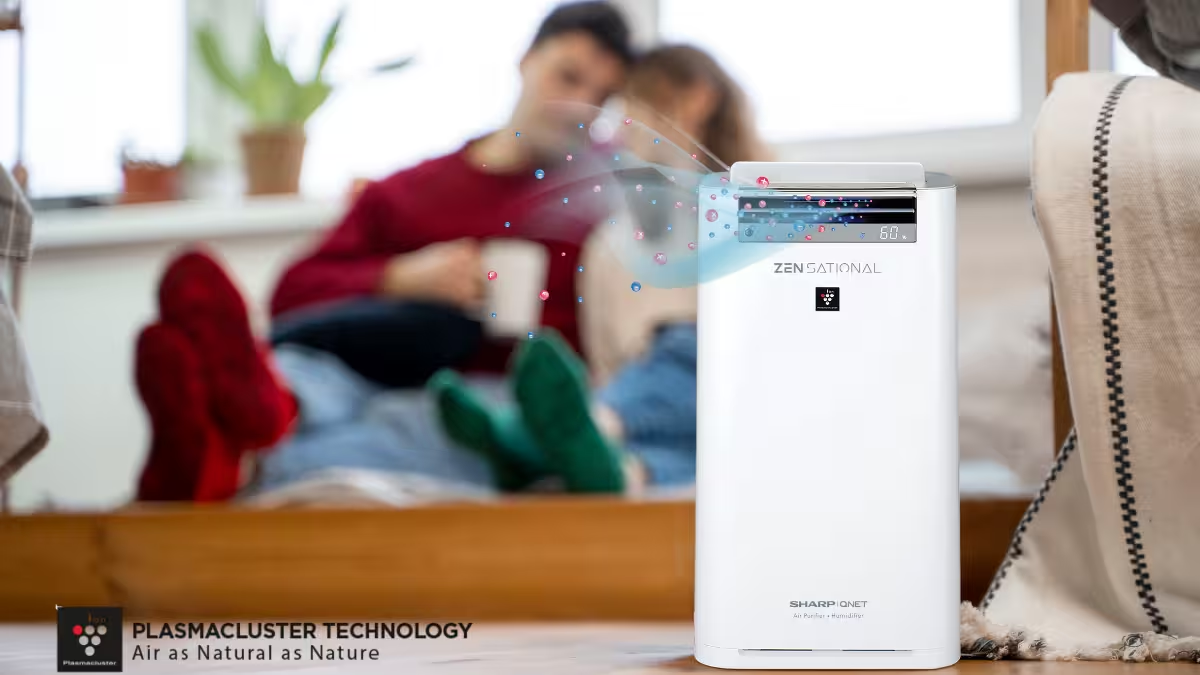
QNET India’s bestselling air purifier – SHARP-QNET Zensational Air Purifier, with patented Sharp Plasmacluster technology, the original sharp air purifier with sanitising technology that purifies the air by emitting positive and negative ions, as present in forest-fresh air, eliminates 99.97% infection causing germs from the air. It also deactivates suspended airborne mould, viruses, dust mite allergens, pollens and bacteria.
Also read: Why You Need the Best Home Air Purifier this Summer
It has a True HEPA filter that captures particles as small as 0.3 microns, while the dual-action PANDAA filter converts harmful gases into harmless ones. The unit also integrates a humidifier that keeps skin healthy and guards against throat infections.
Equipped with seven detection modes that monitor PM2.5, dust, odour, temperature, humidity, light and motion, it allows the purifier to adapt continuously to your environment, without any manual intervention. It is, simply put, the first of its kind in this category.
Read more about it here and make the healthy choice for your family.